
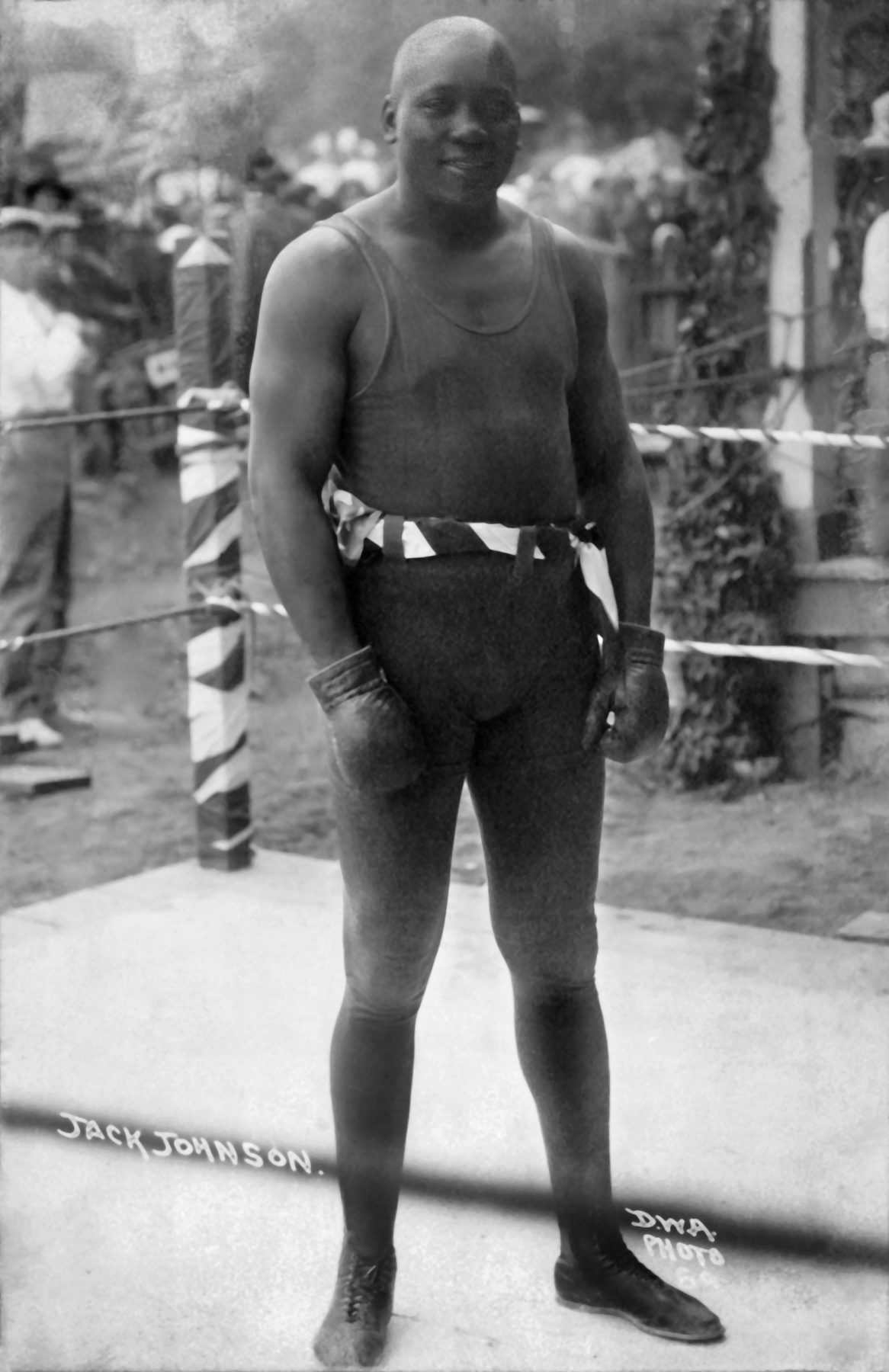

Before it was the Cotton Club, the second floor on the corner of 142nd Street and Lenox Avenue was Jack Johnson's supper club. A short history of the first Black heavyweight champion, told from a Harlem room he did not get to keep.
The building is gone, and so is the name over the door. But for a few years in the early 1920s, the upper floor at the corner of 142nd Street and Lenox Avenue held a small supper club called the Club Deluxe, and the man who rented it had once been the heavyweight champion of the world.
Jack Johnson came to that room late in a life that had already been tried in public. He was born in Galveston, Texas, on March 31, 1878. He won the title on December 26, 1908, in Sydney, Australia, after following the champion, Tommy Burns, around the world for two years and taunting him in the newspapers until Burns agreed to fight. Johnson won. Joe Gans had become the first Black world champion at lightweight six years earlier. Heavyweight was different. Heavyweight was the title people treated as a statement about who was strongest in the world, and a great many white Americans did not want that statement made by Johnson.
Reno, and what came after
The answer they reached for was James J. Jeffries, the retired former champion, who came back for one fight. It took place on July 4, 1910, in a ring built for the occasion in downtown Reno, Nevada, in front of about 20,000 people. Johnson won. That evening, from Texas to New York, white mobs attacked Black Americans who had celebrated or were simply in the street. Riots broke out in more than 25 states and 50 cities. At least twenty people were killed and hundreds more were injured.
Johnson did not make himself smaller after that. He married white women, drove fast cars, and in July 1912 opened an interracial nightclub in Chicago, the Café de Champion. In October 1912 he was arrested under the Mann Act, the federal law against transporting women across state lines for "immoral purposes," over his relationship with Lucille Cameron, an eighteen-year-old from Minneapolis. Cameron refused to cooperate, and that case fell apart. She married him that December.
Prosecutors found another witness. In June 1913, in the courtroom of Judge Kenesaw Mountain Landis, an all-white jury convicted Johnson on the strength of trips that took place before the Mann Act was even passed. He was sentenced to a year and a day. Landis would later become baseball's first commissioner and kept its color line in place until his death.
Johnson left the country. He joined Cameron in Montreal on June 25, 1913, then went on to France. He spent seven years abroad, in Europe, South America and Mexico, still taking fights. On April 5, 1915, at the Oriental Park racetrack in Havana, in front of a crowd of about 25,000, he lost the title to Jess Willard. Johnson later suggested he had thrown it, and many people believed him. That claim is disputed and belongs with the lore, not the record.
The Harlem years
He came back on July 20, 1920, surrendering to federal agents at the Mexican border. He served his sentence at the federal penitentiary in Leavenworth and was released on July 9, 1921.
Harlem in those years was becoming the place the rest of the country would later name a renaissance. Johnson took the upper floor at 142nd and Lenox and ran an intimate supper club there. Then, in 1923, a bootlegger named Owney Madden, newly out of Sing Sing, took over the operation and changed the name to the Cotton Club. The arrangement reportedly kept Johnson on as manager.
What Madden built upstairs is well documented, and it is not a comfortable story. The Cotton Club booked the finest Black entertainers in the country, Duke Ellington, Cab Calloway, Ethel Waters, Lena Horne, and for years it would not let Black customers through the door. In the room where the first Black heavyweight champion had hosted his own guests, the audience was white and the people on stage were not.
The club stayed on Lenox until 1936, when it moved downtown to Broadway and 48th Street.
A pardon, 105 years on
Johnson kept fighting exhibitions and paid bouts for years, and he kept driving. On June 10, 1946, he and a friend were on their way to New York from Texas when they stopped at a segregated diner in North Carolina that refused to serve him. He drove off angry. On U.S. Highway 1 near Franklinton, the car hit a telegraph pole. The friend survived. Johnson died that evening at St. Agnes Hospital in Raleigh, the nearest hospital that would treat Black patients. He was 68. He is buried at Graceland Cemetery in Chicago, beside his first wife, Etta Duryea Johnson.
The push to clear his name ran for decades. A resolution passed the House in 2008 and stalled in the Senate. Petitions went to the White House in 2009 and 2016. On May 24, 2018, Johnson received a posthumous presidential pardon, 105 years after the conviction.
You can stand at 142nd and Lenox now and see nothing that tells you any of this happened. The plaque, if there is ever a plaque, will have a lot to fit.
In the room where the first Black heavyweight champion had hosted his own guests, the audience was white and the people on stage were not.
The Record is the editorial desk of Kings County. Drafted from published histories; dates checked against the sources below. Corrections and additions: write to the editors.
Sources
- Jack Johnson (boxer), biography, Mann Act case, Reno riots, exile, Leavenworth dates, death, 2018 pardon: https://en.wikipedia.org/wiki/Jack_Johnson_(boxer)
- Cotton Club, Club Deluxe origins, Owney Madden, segregation policy, 1936 move: https://en.wikipedia.org/wiki/Cotton_Club
- Geoffrey C. Ward, Unforgivable Blackness: The Rise and Fall of Jack Johnson (Knopf, 2004), and the Ken Burns/PBS film of the same name (2005): https://www.pbs.org/kenburns/unforgivable-blackness/
- Johnson–Jeffries riots (July 4, 1910), background on the Reno fight and the violence after it: https://en.wikipedia.org/wiki/Johnson%E2%80%93Jeffries_riots