
Héctor Camacho grew up in the James Weldon Johnson Houses in East Harlem, won three New York Golden Gloves titles and three world championships, and turned his own entrance into an event. When he died in 2012, East Harlem held a parade.
The James Weldon Johnson Houses are a public housing development in East Harlem named for the poet and civil rights leader who wrote the words to "Lift Every Voice and Sing." Héctor Camacho moved there as a small child. He was born in Bayamón, Puerto Rico, on May 24, 1962, and his mother brought the family to Spanish Harlem, the part of the city that a great many Puerto Rican families arriving in New York called home.
He got into trouble early. Street fights. A jail cell at fifteen. A high school language teacher named Pat Flannery took an interest in him, helped him learn to read, and, by the boy's own later telling, acted something like a father. Camacho had picked up karate and boxing. Flannery steered him toward the Golden Gloves.
Three titles in the Gloves
He won the first of his three New York Golden Gloves championships in 1978, in the 112-pound sub-novice division, and kept winning. He turned professional and moved fast, a southpaw with very quick hands and a habit of letting everyone know it.
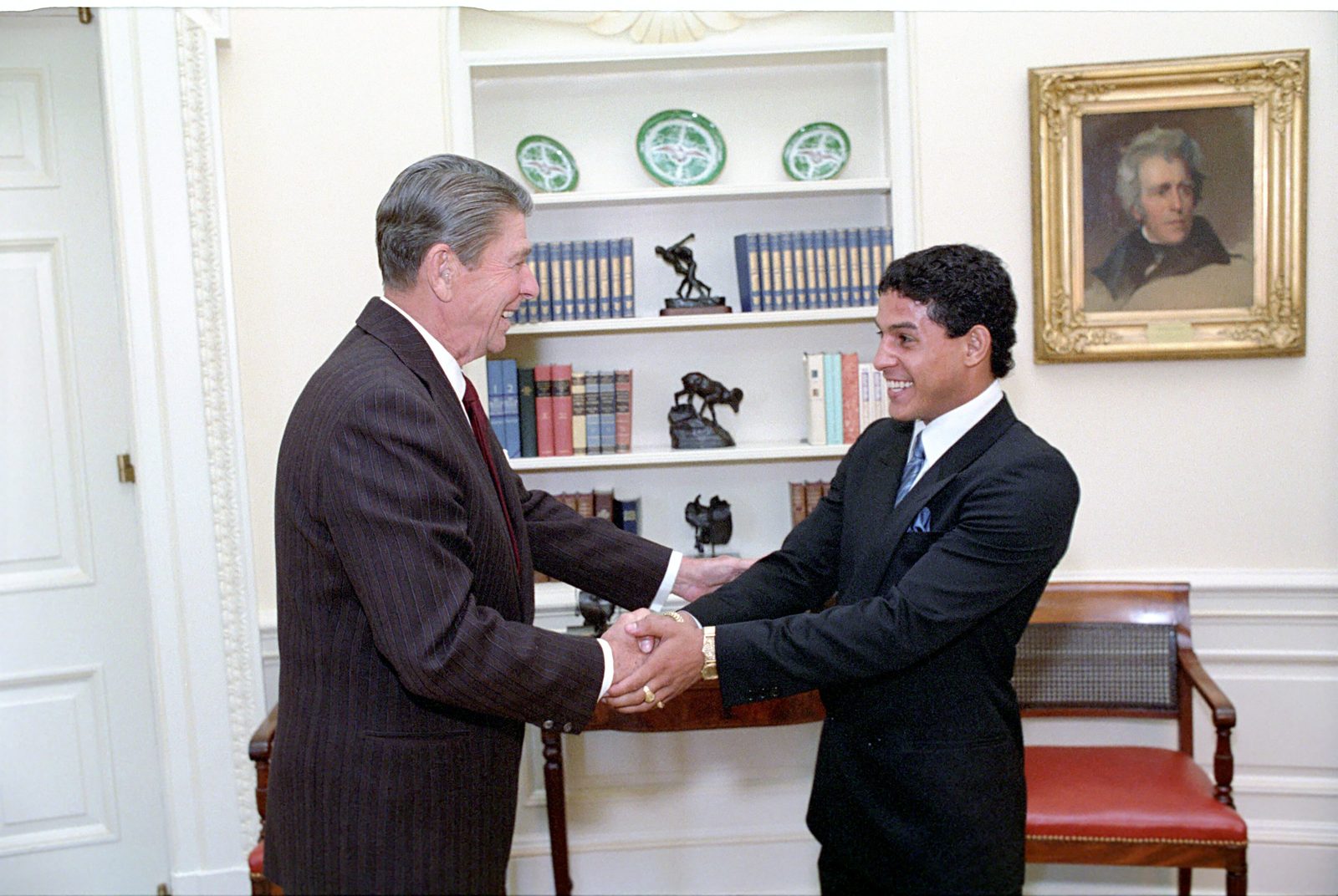
In 1983 he won the WBC super featherweight title, stopping the former champion Rafael Limón in the fifth round after knocking him down three times. It was the first time he had been in the ring with a former world champion. That September, at twenty-one, he was in the Oval Office shaking hands with President Reagan, the photograph at the top of this page. He won the WBC lightweight title in 1985.
The Garden, June 1986
On June 13, 1986, he defended the lightweight title against Edwin Rosario at Madison Square Garden, on HBO. It is the fight people from East Harlem bring up. Camacho controlled the first four rounds. Then Rosario, a puncher from Puerto Rico himself, started landing, and through the fifth, sixth and seventh Camacho held on. He took the eighth and ninth back. Rosario won the last three. Camacho kept the title on a split decision.
He fought on for a long time and fought nearly everyone. In 1989 he beat Ray Mancini for the vacant WBO junior welterweight title, his third world championship in a third weight class, and he held that belt twice between 1989 and 1992. Vinny Paz, Greg Haugen. Julio César Chávez beat him over twelve rounds in Las Vegas in 1992, when Chávez was 81–0. Roberto Durán, twice, late in Durán's career. Félix Trinidad. Oscar De La Hoya. In 1997 he knocked out Sugar Ray Leonard in five rounds and ended Leonard's last comeback.
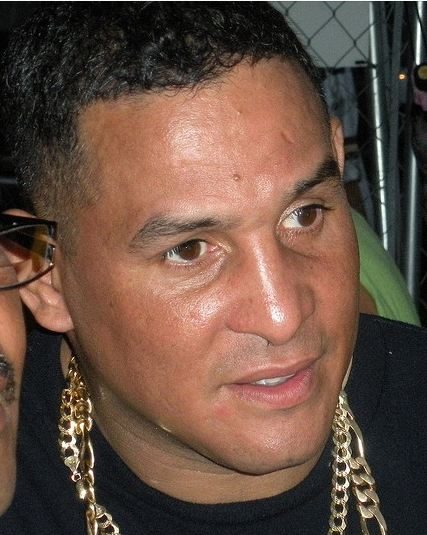
Photo: Azalia Negron / Flickr via Wikimedia Commons, CC BY 2.0.
Macho Time
The nickname and the catchphrase carried him in and out of the ring. He called it Macho Time, and it became the name of a musical sketch on Telemundo's Super Sábados, and later of the title of Christian Giudice's 2020 biography. In his later years he appeared on Spanish-language television, on the dance show Mira Quién Baila and with a weekly segment called "Macho News." His son, Héctor Camacho Jr., born in New York in 1978, became a professional boxer too.
His life outside the ring was not quiet. He had arrests and convictions, including a guilty plea to a 2005 burglary charge in Gulfport, Mississippi, for which he served probation and house arrest. He acknowledged drug abuse. The record is not hidden and should not be.
November 2012
On November 20, 2012, Camacho was sitting in the passenger seat of a friend's car outside a bar in Bayamón when someone in a passing vehicle opened fire. The driver, a childhood friend, was killed. Camacho was shot in the jaw. He was taken to a hospital in Bayamón, and after doctors found only minimal brain activity his mother asked that life support be removed. He died on November 24. He was fifty.
Before his burial, East Harlem held a parade for him. In March 2022, nearly ten years later, Puerto Rico's Department of Justice arrested five suspects in the shooting.
The Johnson Houses are still there. The block he came up on was one of the places that parade was for.
He called it Macho Time, and for a few years in the 1980s the whole of East Harlem kept his schedule.
The Record is the editorial desk of Kings County. This piece concerns a violent death and is published without any product content. Corrections and additions: write to the editors.
Sources
- Héctor Camacho (birth, James Weldon Johnson Houses, Flannery, Golden Gloves, titles, Rosario, Chávez, Leonard, TV, legal history, shooting, death, East Harlem parade, 2022 arrests, Giudice biography): https://en.wikipedia.org/wiki/H%C3%A9ctor_Camacho
- Ronald Reagan Presidential Library photo, Sept. 22, 1983, via Wikimedia Commons / DPLA: https://commons.wikimedia.org/wiki/File:President_Photo_Op._with_Super_Featherweight_Boxing_Champion_Hector_Camacho_in_Oval_Office_-_DPLA_-_a6468b9d32d731f03aa083051c23d1d5.jpg
- Christian Giudice, Macho Time: The Meteoric Rise and Tragic Fall of Hector Camacho (Hamilcar Publications, 2020)